
What Is Web Design? A Complete Beginner’s Guide (2026 Edition)

A great website isn’t just a collection of pages — it’s the digital face of your brand. In the online world, where attention spans are short and competition is fierce, your website often makes the first impression on potential customers. Whether you run a small business, a large corporation, or a personal portfolio, your site’s design directly influences how users perceive your credibility, professionalism, and value.
This is where web design comes in.
In this detailed guide, we’ll explore what web design means, what web designers actually do, what tools they use, and why it’s such an essential part of modern digital marketing.
Infographic – What Is Web Design
What Is Meant by Web Design?
Web design is the process of planning, conceptualizing, and arranging content online to create a functional and visually appealing digital experience. It’s the combination of art, psychology, and technology to present content that people can interact with intuitively.
In simpler words:
Web design is about how a website looks, feels, and functions to ensure users enjoy the experience while achieving their goals.
 Core elements of web design include:
- Layout: The arrangement of text, images, and functional elements like buttons or forms. A well-structured layout improves readability and conversion rates.
- Color Scheme: Colors influence mood and emotions. For example, blue evokes trust (used by tech companies), while red conveys urgency (used by e-commerce sales banners).
- Typography: Fonts affect personality. Clean sans-serif fonts (like Poppins or Open Sans) are popular for modern web design.
- Imagery and Icons: Visuals help communicate faster than words. High-quality, relevant images improve engagement.
- Navigation: How users move from one page to another — good navigation means visitors find what they need in seconds.
- Responsiveness: With over 65% of web traffic now coming from mobile devices, a responsive design ensures the site adjusts to all screen sizes.
- Content Hierarchy: Deciding what content appears first, what’s emphasized, and how users flow through information.
Today, web design goes beyond aesthetics. It includes usability, performance, accessibility, and even search engine optimization (SEO). A visually stunning site that loads slowly or confuses users won’t perform well — design and functionality must go hand in hand.
Is Web Designing Easy?
This is one of the most common questions beginners ask — and the answer depends on what level you want to reach.
Web designing is easy to start but challenging to master.
If your goal is to build simple personal or business sites, tools like Wix, Squarespace, or WordPress make it easy. You can use templates and drag-and-drop builders to go live in a few hours.
But if your goal is to design professional, high-performing websites that stand out, you’ll need to learn and apply more advanced concepts like:
- HTML, CSS, and JavaScript (the building blocks of websites)
- UX/UI principles (user experience and interface design)
- Conversion optimization (design that drives clicks and sales)
- Search Engine Optimization (SEO)
- Accessibility standards (WCAG 2.1)
- Page speed and performance optimization
Think of web design like cooking: anyone can learn to make a simple dish quickly, but becoming a great chef takes time, practice, and creativity.
The 7 Essential Steps of Web Design (2026 Complete Guide)
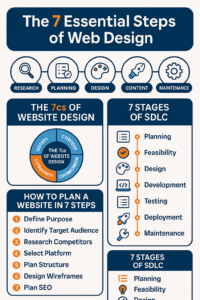 Whether you’re building a personal portfolio, an e-commerce store, or a corporate website — web design is much more than just choosing colors or fonts. It’s a structured 7-step process that transforms an idea into an engaging, functional, and user-friendly digital experience.
In this guide, we’ll explore:
- The 7 steps of web design
- The 7 phases of the web design process
- The 7Cs of effective website design
- The 7 stages of SDLC (Software Development Life Cycle)
- And how to plan a website in 7 steps effectively
Let’s break it down.
What Are the 7 Steps to Web Design?
Every successful web design project follows a process. Skipping steps leads to confusion, rework, and poor results.
Here are the 7 essential steps to web design in 2025:
- Research & Discovery
- Planning & Strategy
- Wireframing & Design
- Content Creation
- Development & Coding
- Testing & Launch
- Maintenance & Optimization
Let’s explore each step in detail.
Research & Discovery – Understanding Goals
This is where everything begins.
Before opening Figma or WordPress, you must understand the brand, target audience, and purpose of the website.
Key tasks:
- Identify target users (age, region, device type)
- Research competitors’ websites
- Define the website’s purpose — informational, transactional, or portfolio
- Note key performance indicators (KPIs): conversions, leads, or traffic
📊 Fact: According to Adobe’s 2024 study, 59% of visitors decide whether to stay or leave a website within the first 5 seconds — so clarity from the start is vital.
Planning & Strategy – Blueprint for Success
Once the research is done, you create a roadmap.
Key planning elements:
- Sitemap: A structural diagram showing all pages (Home, About, Services, Contact).
- User Journey: How visitors move through the site.
- Technology Stack: Decide tools (HTML/CSS, WordPress, Webflow, React).
- Timeline & Deliverables: Assign roles and milestones.
🎯 Tip: Tools like Miro, Whimsical, or FlowMapp help visualize your sitemap effectively.
3️⃣ Wireframing & Visual Design – Building the Skeleton
Wireframing is where design takes shape.
You create low-fidelity blueprints — layout sketches showing where text, images, and CTAs go.
Then, you move to UI (User Interface) design using Figma, Sketch, or Adobe XD.
Design must include:
- Proper color hierarchy
- Readable fonts
- Balanced white space
- Responsive layout for all devices
📈 Fact: 75% of users judge a company’s credibility based on its website design (Stanford Web Credibility Research, 2024).
4️⃣ Content Creation – Words that Sell
Design attracts, but content converts.
Content includes:
- SEO-optimized website copy
- Product descriptions
- Blog articles
- Visuals, infographics, and videos
Focus on clarity, emotion, and conversion.
Each page should have one clear message and one CTA.
📘 Tip: Use storytelling to make content memorable. People remember stories 22× more than raw data.
5️⃣ Development & Coding – Bringing Design to Life
Now the fun (and technical) part begins.
Developers convert the approved design into a functioning website using:
- Front-end: HTML, CSS, JavaScript (React, Vue, Bootstrap)
- Back-end: PHP, Node.js, Python, databases (MySQL, MongoDB)
- CMS: WordPress, Webflow, Shopify
Responsive design, loading speed, and accessibility are critical at this stage.
🧠 Pro Tip: Use GitHub for version control to manage updates collaboratively.
6️⃣ Testing & Launch – Quality Assurance
Before launching, test everything thoroughly.
Checklist:
- ✅ Mobile responsiveness
- ✅ Cross-browser compatibility
- ✅ Page load speed
- ✅ Forms and buttons
- ✅ Security (SSL, HTTPS)
- ✅ SEO readiness (meta tags, alt text)
Once the site passes testing, it’s launched to a live server.
🎉 Fact: A one-second delay in page load can reduce conversions by 7% (Google UX report, 2024).
7️⃣ Maintenance & Optimization – Keep It Fresh
A website is never truly “done.”
After launch, continuous maintenance ensures long-term success.
Ongoing tasks:
- Update plugins and security patches
- Analyze analytics data
- Improve SEO ranking
- Refresh visuals and content quarterly
🔁 Tip: Schedule a monthly health audit. A well-maintained site improves trust and Google rankings.
🌐 What Are the 7 Phases of Web Design?
The seven steps above can also be viewed as phases that flow sequentially:
| Phase | Focus | Deliverable |
|---|---|---|
| 1 | Research | Client brief, audience persona |
| 2 | Planning | Sitemap, wireframe draft |
| 3 | Design | Final UI/UX mockups |
| 4 | Content | Copy, images, brand voice |
| 5 | Development | Website prototype |
| 6 | Testing | QA reports, fixes |
| 7 | Launch & Maintenance | Live website & updates |
Each phase builds upon the previous — skipping one often results in design flaws or miscommunication.
🧩 What Are the 7 Stages of the Design Process?
Design, whether for web, branding, or product, generally follows seven universal stages:
- Define the Problem – Why are we designing this?
- Research – Understand users and market trends.
- Ideate – Brainstorm creative approaches.
- Prototype – Build initial mockups or wireframes.
- Test – Validate ideas with feedback.
- Refine – Polish based on testing insights.
- Implement – Deliver the final design.
These stages emphasize the creative loop — constant feedback and improvement.
💎 What Are the 7Cs of Website Design?
The 7Cs model is a timeless framework to evaluate a website’s quality.
It ensures balance between creativity and functionality.
| C | Description |
|---|---|
| Context | Visual design and layout consistency |
| Content | Quality of text, images, and multimedia |
| Community | How users connect and interact |
| Customization | Personalized user experiences |
| Communication | Clear messaging and navigation |
| Connection | Integration with other platforms |
| Commerce | Smooth transactions and conversions |
📊 Fact: Websites that follow the 7Cs framework have 28% higher user retention, according to UXDesignLab’s 2025 report.
🗺️ How to Plan a Website in 7 Steps
Planning determines 80% of your project’s success.
Here’s how to plan effectively:
- Define Purpose: Clarify goals (sales, branding, education).
- Identify Target Audience: Age, demographics, pain points.
- Research Competitors: Analyze what’s working for them.
- Select Platform: Choose CMS (WordPress, Webflow, Shopify).
- Plan Structure: Create sitemap and content hierarchy.
- Design Wireframes: Visualize user flow and layout.
- Plan SEO: Use keyword research, meta tags, and internal links.
🧠 Tip: Create a project brief document summarizing all 7 steps before starting.
🎨 What Are the Seven Elements of Design?
These seven elements form the visual foundation of every website:
| Element | Description | Example |
|---|---|---|
| Line | Defines shapes, guides eye movement | Borders, dividers |
| Shape | Adds structure or emphasis | Buttons, icons |
| Color | Creates mood and contrast | Brand palette |
| Texture | Adds depth or realism | Backgrounds |
| Space | Improves readability | White space |
| Form | 3D illusion or layout depth | Shadows, layering |
| Typography | Communicates tone | Font choice, headings |
📘 Tip: Combine these elements with a consistent grid system for visual harmony.
💻 What Are the 7 Stages of SDLC (Software Development Life Cycle)?
When web design overlaps with web development, it follows SDLC — the Software Development Life Cycle.
| Stage | Description |
|---|---|
| 1. Planning | Identify project goals and resources. |
| 2. Feasibility Study | Check technical and financial viability. |
| 3. Design | Create architecture, prototypes, UI design. |
| 4. Development | Write actual code and integrate databases. |
| 5. Testing | Detect bugs, ensure performance. |
| 6. Deployment | Launch live application or website. |
| 7. Maintenance | Update, patch, and optimize regularly. |
🧠 Note: The SDLC ensures a project is completed on time, within budget, and error-free.
📈 How These 7s Connect: The Ultimate Web Design Framework
Let’s connect everything you’ve learned:
| Focus | Framework | Purpose |
|---|---|---|
| Design Process | 7 Steps | End-to-end project execution |
| Creative Thinking | 7 Stages | Idea to prototype |
| Quality Standards | 7Cs | Evaluate user experience |
| Tech Development | 7 SDLC Stages | Manage development lifecycle |
Together, these 7-based models create a holistic web design ecosystem — from concept to coding to client satisfaction.
💬 Real-World Example: Arkido Web Services Process
At Arkido Web Services, every client project follows the same 7-step framework:
- Discovery meeting to understand client needs.
- Sitemap + timeline creation.
- Figma design mockups.
- SEO-based content writing.
- Development in WordPress or custom stack.
- Testing across 30+ browsers/devices.
- Ongoing monthly maintenance & Google Analytics tracking.
This ensures consistent quality and faster delivery for small businesses and enterprise clients alike.
🏁 Conclusion
The 7 steps of web design are not just a checklist — they’re a blueprint for success.
From discovery to maintenance, each phase builds structure, creativity, and measurable performance into your website.
Whether you’re a beginner designer or managing a team, following these 7 frameworks (Steps, Phases, 7Cs, Elements, and SDLC) ensures your website stands out in a competitive digital world.